Saturday, 26 March 2022

Still in the game

Many of us have been surprised - indeed awestruck - by Ukraine's determined resistance against Putin's invasion. The experts were pretty united about the likely outcome when Russia invaded. Eliot Cohen published an analysis in The Times a few days ago saying why the experts had got it wrong about Ukraine's ability to resist the initial assault. Like many people who know much more about it than I do, I was a little surprised that the Russians hadn't opened up with more of a shock and awe approach. I assumed that this was because they preferred to try to occupy a functioning country. And I still thought it would be over in Russia's favour fairly quickly. I also presumed that when the Russians reverted to Grozny and Aleppo style bombardment as plan B - as deployed at Mariupol - that Ukraine's collapse would be slow rather than quick but would still happen as I feared that Kyiv would soon face a similar fate.

The best I felt we could hope for was a long drawn out stalemate and possibly a partitioned Ukraine.

But Cohen said the experts (and the mere opinionated like me) were wrong on that also. He said that the more likely truth is that the Ukraininans were winning for which there was "abundant evidence" and that the failure of the experts to recognise it will be one of many elements of this war worth studying in the future. In the subsequent days the tide does seem to have turned and Russia has retrenched to focus on its primary objectives in the south and east. Nevertheless it's worth looking at why Cohen was predicting this (actually to him it wasn't a prediction as it was already happening). He said:

"The Ukrainian miltary has proved not only motivated and well led but also tactically skilled, integrating light infantry with anti-tank weapons, drones and artillery fire to defeat much larger Russian miltary formations. The Ukrainians are not merely defending their strong points in urban areas but manoeuvring from and between them, following the Clausewitzian dictum that the best defence is a shield of well-directed blows. The reluctance to admit what is happening stems perhaps in part from the protectiveness scholars feel for their subject (even if they loathe it on  moral grounds), but more from a tendency to emphasise technology (the Russians have some good bits), numbers (which they dominate, though only up to a point) and doctrine".

Cohen points out that the areas of Ukraine we see marked in red aren't occupied by Russia per se, but just areas they have moved through. Noting the various credible reports of significant Russian losses and allowing for the likely multiple for numbers out of action wounded, he posits that around 15% of the invading force could have been removed by wounds, capture or disappearance, saying this would be enough to render most combat unites ineffective.

What about reserves? He says the Russian army committed well over half its combat forces to the fight, behind that stands very little and that most of those reserves have no training to speak of. We know Putin may get some Chechen and Syrian forces to bolster his numbers but one wonders how well they would integrate. It is striking that Belarus has not committed troops in support and there are reports that Russian national guard forces, normally considered Putin loyalists, are claiming their service contracts don't provide for them to serve outside Russia. 

So there may not be much behind the front line deployment. It would seem that, if the Russian army is routed at its front line, Ukraine could push them out - a prospect that I had thought existed pretty much only in the mind of its president.

How has it come to this? Cohen points out that:

  • the Russian army command can be rather cerebral and admire elegant tactical and operational thinking rather than pressing hard on practice. Modern armies rely on a strong cadre of non-commissioned officers and Russia's are weak and corrupt without which "even large numbers of sophisticated  vehicles deployed to a compelling doctrine will end up broken or abandoned and troops will succumb to ambushes or break under fire"
  • the repeated tactical blundering, visible on videos even to amateurs, included vehicles bunched on roads, no infantry cover for the flanks, no closely co-ordinated artillery fire, no support from helicopters and panicky reactions to ambushes. The one to one ratio of Russian vehicles destroyed to captured speaks of an army that is unwilling to fight. The inability to concentrate forces on one or two axes of attack, or take a big city, are "striking" as are the problems of logistics and maintenance. (I would add that the Russian military and political hierarchy will suffer from being told over many years only what it wants or expects to hear in a culture where no-one will point out the lack of clothing to the emperor)
  • the Ukrainians have auxiliaries too and, while some may be "worthless or dangerous to their allies" they include snipers, combat medics and other specialists who have fought in western armies. More important they have the military industry of many countries behind them resulting in a flow of thousands of advanced weapons: the best anti-tank and aniti-aircraft weapons in the world, plus drones, sniper rifles and all the kit of war. When the UK was providing anti-tank and anti-aircraft systems and training Ukrainian forces in their use in the run up to the hostilities I felt that it surely couldn't be enough to make a difference, but the west would get to see its kit tested in real battle. It has made an enormous difference
  • I had presumed that the Americans in particular would have extensive intelligence about Russian deployment and intentions from its spy satellite system and that the performance of the Ukrainians suggests that this intelligence must be being shared. Cohen says the adroitness of Ukrainian air defence and deployments means we can suppose this to be correct
  • I had expected Ukraine to collapse quickly into confusion, its communication and other essential systems hit by Russian cyber hackers. But Cohen notes there has been no evidence of Russian cyberwar. I wonder if they aren't as good at it as we feared or the systems the west have provided over the years to the Ukrainians have proved resilient. (I'd also assume that the Ukrainian infrastructure is less connected to the hackable internet than ours). But more than that, it's been the other way around: Russian secure comms systems have been poor or inoperable and their use of conventional unencrypted comms has contributed to Russian generals getting themselves killed. Others have fallen because of their desire to unstick things at front lines. The half a dozen or so generals the Russians have lost has been reported to be about a quarter of the total for the whole of Russia's army
  • and, even when a city is turned to rubble, while we look at the destroyed hospitals and apartment blocks and wonder how people can possibly survive and continue to fight, Phillips O'Brien of St Andrews University has argued this conveys the brutality but not the military reality. Even when a town has been practically levelled, its defenders are unlikely to have been killed off. The Russians should know this from their own experience at the hands of the Germans 80 years ago

It also strikes me that the Ukrainians have used the time since the Russian invasion of Crimea in 2014 very well. They were apparently embarrassed by their inability to offer any significant resistance. I think the photographs of bridges blown up and Russian vehicles ambushed, the evidence that the Russian advance had stalled and the ability of Ukraine to keep its rail system operational, bringing supplies through from its western border with Poland all show to me evidence of advance planning to an extent I doubt could have been done in the few weeks while Russia gathered its invasion force. They have certainly trained their forces well. The BBC reported that many had, of course, seen service fighting the Russian separatists forces in the Donbas. Another point made by Ukrainian troops Mark and Vlad when interviewed by BBC was that, while the Russian forces adjacent to Karkhiv sleep in their trenches, they take turns to sleep under cover in the town, where they have plentiful supplies of in date ready meals (captured Russian troops have are reported to have some meals dated 2015) and where ambulances can still get access to take the wounded out to hospital. 

The reported arrival of nearly twenty plane loads a day of supplies and weapons to an airfield near the Polish border, mainly from the US, must have been absolutely critical. But I saw a cutting comment from a Times reader to the effect that a few weeks ago we thought Russia had the second best army in the world, now it's clear they have the second best army in Ukraine.

Can Ukraine actually do it? Cohen feels they can but it will help if the west double down by arming them on the scale necessary, throttling the Russian economy pressuring an elite that, by and large, he says don't subscribe to Putin's ideology or paranoid nationalism, penetrating his information cocoon which is insulating the Russian people from the reality that thousands of their young men will come home maimed or in coffins, announcing a Marshall plan for Ukraine and beginning to make arrangements for war crimes trials and naming defendants. I had thought the last of these was pointless but I was wrong on that as well: what harm can it do to inject the possibility that what happened to the likes of Ribbentrop and German military figures at Nuremberg and Mladic and Karadzik at The Hague could actually happen to them?

I had also thought that, in the context of modern warfare, Churchillian type speeches had become irrelevant. President Zelensky has proven otherwise. His series of speeches to various parliaments have been inspirational, all cleverly targeted and producing standing ovations, generally followed by a debate. Apart from Germany where their speaker thanked Zelensky perfunctorily and moved on to next business by wishing two MPs a happy birthday! Zelensky was perhaps more critical of Germany than other countries, referring to the country's "worthless" lip service to the Holocaust and how slow it had been to wake up to the true nature of Putin's regime, though to be fair we don't know whether the UK would have been just as keen to buy Russian gas in Germany's position. He also got stuck in to Germany for being the most reluctant to block Moscow from the Swift banking payments system. He said " When we asked for preventative sanctions we...turned to you. We felt resistance. We understood that you want to continue the economy. Economy. Economy" with a bite of sardonic sarcasm in his voice.

Germany's policy towards Russia and China is Wandel durch Handel (change through trade), the idea being that the more it did business with such countries the more democratic and less authoritarian they would become. A former British ambassador to Germany told Dominic Lawson "The German attitude is that trade is the key to harmonious relations and should not be threatened no matter how vilely Russia or China behaves towards its own people. It is a genuine principle but, of course, self-serving." 

Lawson noted a comment by German journalist Raplh Bollmann: "We are in a dep crisis of the German economic model that is not yet in the minds of many Germans: our model depends on exporting to China especially and importing cheap gas from Russia". 

Zelensky's addresses have been very clever and adroit. Germany has moved more on defence in the last few weeks than in many decades but it still has a lot of ground to make up and the Ukrainian president hit that nail firmly on the head.

There was some carping in the UK about how relatively slow the UK was to enact sanctions on Russian oligarchs. The government decided it needed to tighten the law before it could proceed and it's striking to me that those complaining were likely to be exactly the same as those who had accused the government of acting illegally in proroguing Parliament and on other issues. I'm only suprised that they didn't blame Brexit because it did actually have something to do with it - the UK hasn't had experience of sanctioning countries for several decades and has had to relearn it. Never mind that the UK sanctioned Abramovich before anyone else and has now probably acted against as many bodies and people as any other country or group of countries. What is also clear from listening to Zelensky and, come to that, everyday Ukrainians is that the assistance the UK has provided and the leadership the UK has shown in the international community is very much appreciated to the point where I've heard it said that the second most popular politician in Ukraine is Boris Johnson. 

Johnson has so far had a good war, as it were. Oh sure he says some daft things as always, in particular his wilfully misunderstood but crass comment linking Ukraine and Brexit. While I found his remark rather odd, if he'd left it at Ukrainians and Brits tend to choose freedom without bringing Brexit into it as an example for the Brits no-one would have batted an eyelid. Bizarrely Nicola Sturgeon then joined in, saying:

"Putin's war has also cast new light on the realities of Brexit and the particular challenges posed to Scotland and the rest of the UK by being taken out of the world's biggest single market. The events of recent weeks have underlined the importance of independent countries co-operating in supranational organisations such as the EU. That is why we are determined to achieve independence for Scotland by offering the choice of a better, fairer future."

Wow. What a bunch of convoluted non sequiturs. Sturgeon's remarks were condemned as unacceptable and tasteless but I'm left wondering firstly why on earth either politician would make such strange remarks. More importantly, as regards Sturgeon's statement, we could question very seriously whether Ukraine being in the EU would have made the slightest difference. You might want to be in the EU, Nicola, but in this context I'd suggest NATO is rather more important. And having your own nuclear deterrent. I daresay if you get your independence you'll freeload like Germany on defence spending and want the nuclear bases removed while being secretly glad that Britain will maintain the deterrent and would not dare leave the northern part of the island exposed.

It seems to me that despite Johnson's never ending ability to say daft things, he has done pretty well as one of the main western leaders pushing for action and unity. Indeed I read that Canadian PM Trudeau praised Johnson at one of the early international meetings for being able to find the words to get the leaders on the same page. The actions the UK took in providing lethal aid early (stepping it up before the Russians invaded) and pressing for concerted action via Swift etc seem to me a damned sight more relevant than prioritising sanctioning some oligarchs. Especially since at that point pusillanimous Germany was refusing to let our lethal aid even transit their airspace en route to Ukraine and was itself sending field hospital equipment (useful but hardly likely to change the outcome). The sea change in the German response was welcome but needs to be just the start.

If you doubt that Johnson has done well so far, reflect on two things. Firstly sleepy Joe Biden's ability to say even dumber things (what on earth did he mean when he told American troops in Poland that they would see for themselves when they got to Ukraine? Is he trying to start a nuclear confrontation?). And secondly, Russia's reaction when they described Johnson as "the most active participant in the race to be anti-Russian" and called him public enemy number one.

The fact that internationally Johnson has been seen to leading the west's response as much as Biden may not compute to those ordinary Brits who've had enough of him. But either way it doesn't mean the PM is in the clear once Plod finally concludes its risible investigation into Partygate. To be fair the Met can't really win on this: quick and cheap or drawn out and expensive, many have made their own mind up either way and depending on that will find the investigation flawed. So why take quite so long and spend quite so much on it?

The inevitable question to come will be whether a few fixed penalties whoever they land on will be enough to make people decide the PM should be brought down over his failure to set an example to civil servants who didn't directly work for him while the world has been looking into the abyss.

A week ago I would have said Zelensky was more in the no-win situation. Now it's not so clear. It will become clear in time. But for now, both Johnson and Zelensky are still in the game. Except for Zelensky it's not a game. It's life and death. One can only watch in admiration and hope for him and his people.

I'll leave you with this photo of the Russian embassy in Lisbon, illuminated by protesters in Ukraine's colours. (From twitter but fact checked as true)


 ****

Cohen's piece The experts were wrong: Russia hasn't won and isn't going to was in The Times on 23 March

Ukrainian troops Mark and Vlad told the Russians "go home while you are still alive" in item on BBC website on 24 March and video that was shown on the tv news; https://www.bbc.co.uk/news/world-europe-60860548

The Bundestag reaction to Zelensky's speech and the German media's reaction to it is covered in https://www.politico.eu/article/zelenskyy-speech-sparks-soul-search-germany/. It was also noted in Dominic Lawson's Sunday Times column on 20 March, "Zelensky lays bare Berlin's failed strategy"

Decoupling from China would be a much bigger issue than Russia for the west. For example, VW had a 14.6% share of the Chinese market in 2019. The nearest competitor had 7.3%. VW sold 4.184m units in China in 2018 compared with 4.326m in the EU; from https://daxueconsulting.com/volkswagen-in-china/. I read that half of all VWs are made in China.

Russia says Johnson is the most active particpant in the race to be anti-Russian https://www.independent.co.uk/news/uk/politics/boris-johnson-kremlin-attack-russia-ukraine-b2043073.html?r=76065


Tuesday, 22 March 2022

Best musicians I've seen: Guitarists encomia* resumed! 4.7 Guitarists

A significant chunk of a lifetime ago I was writing a series of posts on the musicians I considered to be the best I happen to have seen play live. Other things have intervened but I have contracted covid so the long list of outstanding tasks - and walking, and golf - are out for a few days. So here I resume my encomium* on the best guitarists I've seen play.

To save you looking back, guitarists I've written about from the very large number I've seen included Carlos Santana, Richie Blackmore, Tony Iommi (who arguably created the doom laden sound of heavy metal) and Peter Buck, none of whom made my shortlist and David Gilour, Jimmy Page and Robert Fripp, who did.

Before moving on to my final shorlisted guitarist, other prominent guitarists I've seen include Keith Richards (fourth on Rolling Stone magazine's list compiled by celebrity guitarists**), Pete Townshend (10th) and Dave Davies (91st). These three guitarists illustrate why my original question - who was most the master of his instrument - probably doesn't make sense. Rock music isn't like classical, where a virtuoso violinist's creativity is limited to interpretation (unless they also compose, which is rare). The reason Richards is so high on the list clearly isn't just his skill as a player. C'mon, he wrote the riffs to Satisfaction and Gimme Shelter! And Dave Davies slashed his speaker cone to produce the rasping sound likened to a "barking dog" by one music industry executive, changing Ray's gentle acoustic riff for You Really Got Me into the template for punk. And, according to Mike Rutherford of Genesis, "still one of the greatest riffs of all time". These guys were hugely influential innovators.

Moreover some of the best guitarists I've seen have been hired guns, albeit longstanding ones in the case of Daryl Stuermer who was brought in by Genesis to cover for Steve Hackett in 1977 and has played with them ever since. I haven't seen Hackett, another innovative guitarist, but Stuermer knocks those guitar pieces off like shelling peas (or a virtuoso violinist). When I saw Genesis last year Phil Collins wryly introduced Starmer as being indispensible, as the one who actually knew how to play all the songs. I'd probably add Rick Fenn to that list, who has filled in for Eric Stewart on guitar in 10CC very capably, also since the 70s.

So I don't think you can completely separate skill on the instrument from creativity in this context (Rolling Stone clearly didn't).

Others I've seen included Frank Zappa (22nd on Rolling Stone's list, a great musical magpie and writer of the superb extended guitar solo in Willie The Pimp, a very memorable gig when I saw him in Manchester). It's possible Zappa should be in my shortlist, but he isn't. Another that easily could have been is too obscure for the RS list: Del Bromham of Stray, formed in 1966 and still gigging. I recall their first album being played at teenage parties but didn't buy it until after I saw them playing at a pub in Derby around 2010. As noted by several music publications, Stray may not have gone platinum but  Bromham is seriously good. Hearing Harry Farr made me turn round, go to the back and buy the CD before they had started the next song, something I'd never done before. Del is partial to a bit of Hendrix influence but, as a pure guitar player, I suspect he's actually better than most of the names mentioned above. When we saw them again at The Flowerpot (a pub where Mrs H wouldn't have a drink and avoided going to the toilet!) our younger son laughed at how good they were: "there are bands filling stadiums who aren't as good as this".

My last shortlisted guitarist is also partial to a bit of Hendrix influence, but rather better known, mainly for his various stints with the Red Hot Chili Peppers. Influenced by Beck, Page, Gilmour, Hendrix and Zappa (not a bad list!) the young John Frusciante was a fan of the Chilis and knew the original guitarist, Hillel Slovak, who died of an overdose. He knew many of the riffs of their early songs, which gave him a head start when, having already jammed with bassist Flea, he auditioned for the role. He had been due to audition for Zappa's band but pulled out when he realised that Zappa, who ran his band with an iron hand, strictly prohibited drug use. "I realized that I wanted to be a rock star, do drugs and get girls, and that I wouldn't be able to do that if I was in Zappa's band" though by the age of 20 he turned away from hedonism and ended his first stint with the Chilis because, driven by sales of the seminal Blood Sugar Sex Magik album, he found the bands sudden success disorientating. He went back to drugs and then back to the Chilis, living a more health conscious, spiritual lifestyle. In this phase the band produced their biggest selling album Californication  and their other major sellers besides Blood Sugar, By The Way and Stadium Arcadium, which they were touring when I saw them twice. In this phase the band coupled their hard edged funk with a more commercial pop-rock style to great effect.

I recall reading a newspaper article on guitarists which advocated four as the greatest of all time. I can't recall who they all were but two were George Harrison and John Frusciante. The reasoning was that it was impossible for any guitarist to come up with a more appropriate guitar section for a Beatles or Chilis song than Harrison and Frusciante had. Any cover version has to be rendered in a very different style to stand a chance of working - and most don't. Frusciante sounded immaculate live but listening to his recordings I am consistently astounded by how his playing is always perfect for the song on those classic Red Hot Chili Peppers albums. To the point where I listen to the double Stadium Arcadium album all the way through quite often, even though there are some fairly average tracks, because I can't stop listening to what the Frusciante is doing.

Yes some of it is inevitably derivative: he's 26 years younger than Jimmy Page so that's inevitable.

But John Frusciante is the final guitarist on my shortlist making it Page, Fripp, Gilmour and Frusciante.

I guess I now have to choose just one...

To be continued.

* a word I learned recently. I shouldn't assume that, because I didn't know this word, readers won't but just in case it's a speech or piece of writing that praises someone or something highly. I am reminded of a female comedian we saw support John Bishop last year. She was great - bonny, loud and very rude, with swear words very prevalent. She noted that she hates it when anyone says to her that swearing is a sign of a limited vocabulary, her standard response being "isn't that a bit of a solipsistic assumption for a tw*t?" Anyway, apologies for my solipsistic assumption

**  https://www.rollingstone.com/music/lists/100-greatest-guitarists-20111123

As ever Wikipedia is indispensible: https://en.wikipedia.org/wiki/John_Frusciante

My earlier posts were Best Musicians I've seen - 4.1 guitarists, 8 April 2018 which featured Carlos Santana; 4.2 Richie Blackmore, 22 April 2018; 4.3 Tony Iommi, 24 May 2018, 4.4 - David Gilmour; 4.5 Jimmy Page, 22 June 2018; 4.6 Peter Buck and Robert Fripp, 15 August 2018

Monday, 21 March 2022

Stormy Waters on the Mersey

 Mrs H and I had a day out at New Brighton recently. "A day out at New Brighton" used to be a big thing on Merseyside. I'm pretty sure there was a photo of me as a baby with my parents on New Brighton beach, though I haven't found it so it might be a false memory.  There's still three-quarters of a mile of sandy beach around the tip of the Wirral and, according to Wikipedia, it has the UK's longest promenade. You could get the ferry directly to New Brighton from Liverpool's Pier Head but declining passenger numbers brought an end to that in 1971 and the ferry now shuttles straight across the river to Birkenhead Woodside. (OK pedants, there is also the Seacombe terminal which, like New Brighton, is in Wallasey but right at the Birkenhead end and anyway it's currently out of action for refurb). 

We went to New Brighton for the Fawlty Towers dining experience, which did full justice to the characters of Basil and Sybil Fawlty and their hapless waiter, Manuel. 

Our day out was very windy, with larger waves than I can recall seeing on the river sending spray splashing over the promenade by the Floral Pavilion. My photo above, looking towards the cranes of the north Liverpool docks - the container terminal I think - doesn't really do justice to quite how stormy it was. 

The construction site for Everton's new stadium is somewhat off the right of my photo. The early stages of the work are progressing well. The dock has been filled in and construction has started. Here is the only real heritage feature of the dock, the hydraulic tower, in the process of being preserved notwithstanding the bollocks we heard from UNESCO about the impact of the project on the once world heritage site of the Liverpool Maritime Mercantile city:

However, nothing much else about Farhad Moshiri's project for Everton is progressing well right now.  I couldn't help reflecting that Everton have a stormy passage to navigate a way through to being a Premier League club when they move into the stadium in 2024, assuming of course that it is completed. Everton say the funding for the project is in place, notwithstanding the club ending its sponsorship from sanctioned oligarch Alisher Usmanov.

The Sunday Times threw up a farrago of innuendo about Moshiri and Usmanov last weekend. Moshiri has distanced himself from his even wealthier friend, for whom he was a financial mentor, having first met him while working as an accountant at Deloitte in London in 1989.  By 1993 Moshiri was helping to manage Usmanov's investments in metals, mining, telecomms and technology and they remained close until Moshiri cut links a few weeks ago.

Usmanov rewarded Moshiri with shareholdings in several companies. This might sound unusual but is fairly normal in privately owned companies, the lead shareholder wanting a small number of his main men to have, in that unpleasant phrase, "skin in the game" and a strong incentive for the companies to do well. Usmanov, who Moshiri has described as a "crazy fan of Arsenal" bought into the Gunners with Moshiri but was denied a place on the board by American owner Stan Kroenke. Moshiri funded his purchase of Everton by selling his Arsenal shares to Usmanov. However, the leaked Panama Papers suggested Moshiri's stake was originally a gift from Usmanov in the first place. I'm not sure why this would be materially different to how Moshiri "earned" his wealth but according to Jonathan Northcroft it raises the possibility that Usmanov ultimately paid for Everton. Moshiri has dismissed the documents as a "mistake" and his representatives have said very clearly that Usmanov never had any equity in Everton. Indeed when Everton terminated the sponsorship contracts from Usmanov's USM Holdings I had a good holler at sloppy reporting on the BBC TV news when they described Usmanov as an "investor" rather than a "sponsor" of the club.

It's not clear that any of this presents a problem for Everton from the point of view of sanctions.  After all Moshiri isn't Russian - he's Iranian. He came to the UK with his family as a young man before the 1979 revolution, studying at UCL and is usually described as a British-Iranian businessman. Moreover, all the time Moshiri was working with Usmanov the latter was the opposite of persona non grata with the UK government. I have some philosophical difficulty with politicians who have traded throughout with Russia (and still do) suddenly retrospectively deciding that individuals are beyond the pale for their connections about which we know little more than we ever did. We were buying their oil and gas and, in the case of EU countries particularly Germany and France, selling significant quantities of arms to Putin's regime.

A bigger problem for Everton and Moshiri is that they have wasted so much money during his tenure.  Northcroft reported that Moshiri has "probably injected £450 million into Everton, by far the highest owner funding in the league and double what Roman Abramovich put into Chelsea over a similar period". Some commentators think Everton is at real risk of breaching the Premier League's financial fair play rules. Now FFP is an oxymoron as far as I'm concerned as it is actually designed to keep the current bunch of "elite" clubs at the top forever by preventing speculative investment. Be that as it may, it seems that Moshiri has sunk getting on for a quarter of his fortune into the club which has, unbelievably, spent £668 million on transfers and £40 million paying off a succession of managers in Moshiri's six year stewardship. Unbelievably because the squad doesn't look suffused with quality. They seem to have been a soft touch for agents, who were frequently entertained on Usmanov's yacht for talks about players and managers. 

The result is that Everton recorded a loss of £140m in 2018/19 and £112m in 2019/20, losses that were in the top seven recorded by any English club in history and which totalled more than the combined losses of the nearest two Premier League clubs in the same peiod, Southanpton (£117m) and Manchester City (115m).

Everton say they are confident of being able to show they have operated within the profit and sustainability rules partly because the club has suffered high covid related related losses and have significant new stadium related costs to offset (both permissable).  They were praised for maintaining the pay of their casual staff when there were no matches, in contrast to clubs like Arsenal and they have one of the best community programmes in the UK, if not Europe. All laudable but not great for the business when cash is haemorrhaging. They have apparently been in close contact with the Premier League throughout the season and spend in the summer and January transfer windows was deliberately modest. 

All this is a concern but nothing remotely like the situation on the pitch.

I had another couple of days out on Merseyside over the last ten days with my first visits to Goodison Park since pre-covid. (Thanks, mate, for the loan of your season ticket!) It was also quite like seeing Basil and Manuel though not for me, or most of the crowd, remotely as funny as they tamely lost to a competent but hardly effervescent Wolves team 1-0 in the first match.

Frank Lampard's team selection was strange, with two right backs in the line up. Officially Coleman was ahead of Kenny in midfield but they adopted a curious tactic. When the left back (Ukrainian Mykolenko) went forward the rest of the back four shuffled across with Coleman dropping to right back. This meant that a full back, a winger and two orthodox midfield players were up against the midfield five of Wolves, with predictable results. Neves and Moutinho (who is so old he was coveted by Moyes when he was at Everton) bossed the show and Marcal stood out wide on their left side, offering an almost permananently available out ball when Everton attacked down their left and Coleman vacated that position. Wolves were able to keep the ball and Everton weren't.

Everton's truly awful recruitment policy was illustrated when Mykolenko was substituted by Dele as Kenny moved across to left back. Everton acquired two full backs in January. One, Patterson, has been trusted to play half a game against non-league Boreham Wood. Right footed right back Kenny, who had hardly been able to get a game for three seasons and had been farmed out on loan with a view to a sale, is now preferred to not only Patterson but also left back Mykolenko. That's how much Lampard thinks can trust the new players. 

The fiasco was compounded when Kenny got sent off for two yellow card offences within a few minutes, though at least it meant that, for the second game against Newcastle, Lampard only picked one right back. Instead he picked two left wingers, Gray and Gordon. To be fair Gordon is doing well and has become the fans' great hope, even though it wasn't clear at the start of the season whether Benitez would trust him with many minutes on the pitch. He can operate down either flank, but he was deployed more like a no 10. To see such an inexperienced player trusted with that role was curious, but inevitably he did tend to drift into the same space occupied by Demarai Gray, hence my comment.

In the first match Everton adopted a measured and fairly cautious approach, which meant the crowd never got very animated. By the end there were some boos but the atmosphere was one of resignation. In the second match, under the Goodison lights, the crowd were full throated in desperate support. The team either responded or were sent out to be more pro-active and gave a high energy and determined performance, albeit lacking in much gumption. When ref Craig Pawson gave Allan yellow for a professional foul, VAR categorised it at serious foul play and Pawson upgraded it to red. The offence was pretty much what you see Manchester City do week in week out when they stop the opposition breaking by, in Mikel Arteta's barely English phrase "making a foul". 

It produced lots of noisy indignation as the crowd shouted the team on. They played more sensibly with 10 than they had with 11, defending  effectively and breaking when they could.  It was almost ironic when Alex Iwobi showed great composure to score the winner after being released by substitute DCL, whose presence made a huge impact. Ironic because, at half time in the Wolves match the chaps in front of me were chatting about Moshiri and Everton's transfer "policy". I interjected that we had bought two full backs who, while they might be "ones for the future" the manager didn't trust now. and that Moshiri, while he had a big wallet and his heart was in the right place, didn't have a clue. One of them thought and responded "that's right but just think, without Moshiri we wouldn't have Alex Iwobi".

We all looked thoughtful at this bit of biting sarcasm. The much maligned Iwobi (at least much maligned by me) is thought to have been a personal transfer pick by Moshiri and cost a whacking £30m plus. But he was a hero on Thursday and the stadium was rocking at the end.

Everton gave their fans that very dangerous emotion, hope. My hope is tempered by the fact that, while Everton have games in hand, they have a tough fixture list.

With their morale improving win Everton now have 3 wins in 21 league matches (and only 3 draws as well). More to the point, they have won only one away game all season. It's all very well doing it with that crowd behind you at Goodison - though that can be a mixed blessing in terms of composure as they get too fired up. Two red cards in those matches I saw and, against Newcastle, my heart was in my mouth when both Gordon and Richarlison "went down easily" when already on a yellow. But as Alyson Rudd said recently "on the pitch they are suffering an identity crisis and their away form threatens to land them in big trouble". She wrote that before the 5-0 embarrassment at Spurs.

When you play with commitment at home but are lacklustre away I feel that shows a certain lack of character. (I exclude Richarlison and one or two others from that remark). Everton's upcoming confirmed fixtures, with games to rearrange, are: West Ham (A), Burnley (A), Man U (H), Leicester (H), Liverpool (A) and Chelsea (H). Yes they had a win but Leeds got two, making the table look very much like 3 to be relegated from 4. Not great odds. The Burnley game is huge. If they don't get something out of that I could see them getting 'nil points' from that run of games, putting them deep in the mire by 1 May. 

I haven't seen Everton play league matches in any other than the top tier: they last got promoted when I was two years old. The nightmare scenario is that  they have a shiny new stadium but have been relegated, haven't bounced back at the first opportunity and then run into the far stricter Championship financial fair play rules. We know where that can go: just look at Derby County.

Farhad Moshiri could be the living embodiment of that old joke: how do you get a small fortune? Answer: start with a big one and buy a football club.

P.S. According to a quotable quote by American academic and author Brene Brown hope is "not an emotion; it's a way of thinking or cognitive process". I doubt she knows much about sports fans!

Jonathan Northcroft's column "As if relegation scrap wasn't bad enough Everton are beset by links to oligarch Usmanov and runaway financial losses" was in the Sunday Times 20 March 2022

The Sunday Times reported that the Investigate Europe project had found that EU countries, mainly France and Germany, supplied Russia with €346m of military equipment including missiles, rockets, torpedoes and bombs between 2015 and 2020 - after Russia had seized Crimea!

Alyson Rudd's column "So much of what Everton do off the field makes them a role-model club. But on the pitch they are suffering an identity crisis and their away form threatens to land them in big trouble" was in the Sunday Times on 6 March 2022


Sunday, 27 February 2022

Back in the USSR

We watch with horror the Russian invasion of Ukraine progress with admiration for the bravery and resilience of its people. Ukraine's remarkable Volodymyr Zelensky*, an actor who played a comedy role in which he became an unlikely president only to do so in reality, is acting out the greatest role of his life. Displaying the Ukrainian flag is pretty much an empty gesture, but....

Putin's invason of Ukraine will surely soon take much or all of that country effectively back into the USSR though, unlike the Beatles song, most Ukrainians will not feel lucky. The West woke up too late to a situation which has been slowly unfolding not just over the last few weeks but over many years.

Many strategic and policy errors have been made pretty much since the end of the Cold War. The largest has been assuming that Putin, like Yeltsin and Gorbachev, was "someone we could do business with" while not paying enough attention to the rogue state behaviour of cyber criminality, intrusions into other nations sovereignty (including the UK's with the novichok poisonings) and general mischief making. With hindsight I feel the West acted with a degree of triumphalism over the end of the Cold War which could be likened to the treatment of Germany after World War 1 which, it can be argued, led to the economic collapse of the Weimar Republic, the rise of Hitler and the inevitability of World War 2. I accept, however, that once Yeltsin made the error of annointing Putin as his successor it might have been difficult for  more constructive relationship to have been fostered.

Given Putin's tendencies, which have been evident for a very long time, I opined to Mrs H on our walk a few days before hostilities commenced that the only way I could see that Ukraine just might have saved itself would have been for it to declare itself neutral, like Switzerland or Ireland. I noted that this had one big problem - it wasn't what the Ukrainian people wanted. But, as Mick Jagger sang, you can't always get what you want.

The reason I say this is that I feel the west, in the form of the EU and NATO, flirted with Ukraine, encouraging it to believe that it could become fully and quickly part of the west as its neighbours to the west had done after the fall of communism. The considered opinion was that, for the time being at least, NATO membership could cause more problems than could be answered, leaving Ukraine in limbo and having unsettled the Russians or at least having given them a pretext for grievance.

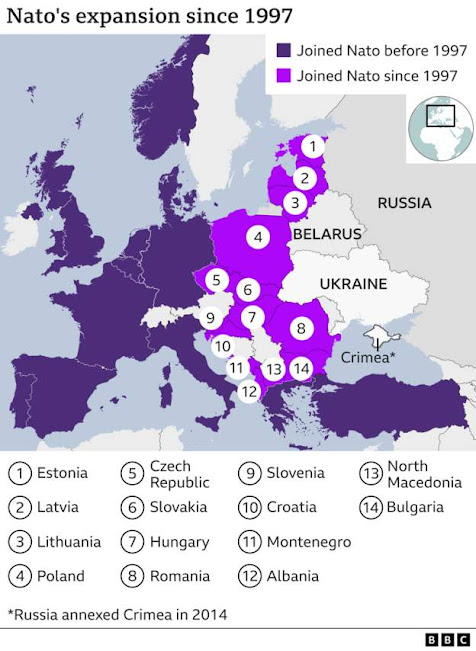
You can see why Russia felt threatened even by an alliance that is inherently defensive and why NATO didn't hurry to admit Ukraine looking at the following map showing the countries admitted to NATO since 1997 (this one comes from many useful maps on the BBC website):

In considering NATO's decision to put admission of Ukraine onto the back burner we have to allow for the fact that Ukraine did not seem particularly stable for much of the last 3 decades. But it's also obvious that Ukraine is incredibly difficult to defend against Russia. Allowing for Belarus being a Russian client state, it currently has hostile borders from ten o clock all the way round to seven. It has been quite a surprise that the Hitleresque tactic of coming through another country (i.e. Belarus) to attack the Ukrainian capital hasn't been promptly successful. However, Putin has clearly not gone for a "shock and awe" bombardment of Ukraine, presumably because he wanted to absorb a functioning country not flatten it. Of course I'm not giving him any particular credit for this small mercy and it might be that he didn't think it was necessary, at least yet. The Russians may have expected their advance special forces to open things up rapidly, coupled with the subterfuge of Russian soldiers in plain clothes and ordinary cars infiltrating into the cities, which has been reported and may or may not be Ukrainian paranoia. 

Putin may also have felt that his "special operation" would have been a bit like Soviet tanks rolling unopposed into Budapest in 1956 and Prague in 1968. 

The reason I think that the West ought to have steered Ukraine to declaring itself neutral, rather than leading it half way up a garden path, is that it has had long historical trading links in both easterly and westerly directions. The country has spent much of the three decades of its independence convulsed over how close a relationship to have with Russia and with the EU. I accept that this argument has been substantially settled in recent years in favour of looking west but Ukraine was not likely to be admitted to the EU anytime soon.

If you doubt just how threatening Russia sees Ukraine being part of the west, just think for a moment what the USA would say - and do - if Mexico announced it was entering into a military alliance with Russia. Or China.

Ukrainian neutrality might have given it the best of both worlds in terms of trading relationships and avoided the need for high spending on defence. I accept that the flaw in my argument is that Putin would still have seen a free Ukraine as a threat to his regime, especially if it thrived economically. The sight of increasing living standards just over the border in a country seen by his people as very similar would almost certainly have caused Putin to go tonto, to use Ben Wallace's term, anyway. It would have inconvenienced Putin to the extent that he couldn't have used "NATO aggression" as a pretext. The bizarre "nazification" claim would still have been available, I suppose.

Plenty of people are saying that we should have stood up to Putin sooner. Many of these are also the same people who oppose war anywhere, were totally against our presence in Iraq and Afghanistan and oppose higher miltary spending whenever it is proposed. Quite a few of them would long since have relinquished Britain's nuclear deterrent. The hand wringing going on now makes me want to ask just what people expected us to do, then or now. 

In the circumstances of now NATO was surely right to make clear it would not fight over Ukraine, especially with Putin's chilling hint of using nuclear weapons if the west got in his way and given what we can tell about his mental state.

So for now we can just marvel at the bravery of the Ukrainian people and assist in any refugee crisis while the West invokes sanctions and provides material (and materiel) aid where it can. And make sure we do spend appropriately on defence and that all NATO partners pull their weight. (Yes, I'm talking about you, Germany - aren't you ashamed at having to finally say you'll meet your commitment of 2% of GDP? Though, you've promised it before, so I'll believe it when it happens).

Personally I would fast track neutral Sweden and Finland's wish to join NATO as well, despite - or because - of Putin's hissy fit over the suggestion.

The West also needs to think carefully about what it can do to destabilise Putin's regime. There is plenty of evidence about just how dangerous going against Putin is for individuals but I do hold out some hope that either the clique of oligarchs around him, or his military leaders, will see that their boss's behaviour has become a liability. The sanctions are broad ranging and, over time, will hit Russia hard. Russia can only lose in an economic war wioth the West. At least we, as individuals, don't need vet many goods for embargo, unlike China.

In the meantime I say "Budmo, Ukraine!" It's the shortest and most common toast in Ukraine and means more than just cheers - broadly "let us be".

* Some sources give the president's surname as Zelenskyy. Of course it's actually Володимир Зеленський, so you can see it does have a double letter at the end but I would have thought the issue is whether we need that to produce the phonetic equivalent. I recall an Iranian student I knew at uni telling me of difficulties he had faced because his surname, spelt phonetically on his passport in American English didn't match his father's, spelt phonetically in French. When I visited Ukraine a bit over 20 years ago the difference between the Ukrainian alphabet and Russian was explained to me as, at first sight standing looking at signs in Kiev, having visited Moscow a few years earlier, I couldn't tell the difference. They are both cyrillic with 33 letters but there are four Russian letters which don't appear in Ukrainian and vice-versa. However the "spot" I was given was that there are two letters which appear in one language quite a lot in common words and which are missing from the other. Of course I don't remember the detail. In practice the languages are more diverse than that would make it seem and non-Ukrainian speaking Russians would apparently struggle to understand much Ukrainian which has a lot in common with the Slavic languages as well as Russian. So much for Putin's "we all all Russ together".

Ukraine has no great strategic interest to the West though it does produce about 8% of the world's grain. This stat was no surprise to me, having been driven for several hours through what seemed never ending wheat growing prairie en route from Kiev to Chernobyl. The news that Russian forces had "taken Chernobyl" made me smirk. None of the four Russian designed reactors there are operational, so it wasn't contributing to power supplies. The striken unit 4, which basically blew up in 1989, is in a stable state and enclosed by a shelter, funded by the West. If Putin really did want to take it back for Russia he truly is crazy, but I'm sure it was just sloppy reporting. Chernobyl is very close to the border with Belarus and there are main roads direct to Kiev (or Kyiv as it seems to have become).


Sunday, 13 February 2022

Osi's nearly right: it rarely disappoints

There are many benefits in being retired. Strangely one of them isn't that I get to stay up and watch more Superbowls on live TV. It all depends what I'm doing the next day. When I retired I decided I should celebrate Mondays. They became "Magic Mondays" because I didn't have to go to work. This was partly because Monday would usually be my longest day of the working week, often leaving the office at 8pm.

A friend who wasn't retired once asked "doesn't it mean the weekends aren't special?" He is now retired and will realise that they still are. That's when your family can come to stay, as they aren't working. And there's the weekend's sport: TV to watch and golf competitions to play in. But Mondays are different.

However, now I have to get up and do stuff on a Monday to make it magic I don't stay up to watch the Superbowl, which I often did while still working. There is of course an old joke about coming back to work for a break to recover after a good holiday. 

And I must admit I do get much more tired after a late night now. Getting old sucks but as I always say, it's better than the alternative. So yet again  I won't be watching this year's Superbowl live, as Mrs H and I have something planned.

The climax to the NFL season always makes me wish I'd watched more of the coverage through the season. As the NFL season starts in early September, just as the football season has got into full swing, I tend to start paying proper attention towards the end of the regular season, as the race for the play offs shakes down. 

But there is so much good sport to keep up with that I' ve gone back to watching gridiron mainly via the highlights shows, which was how I got into watching it back in 1982 when Channel 4 first broadcast the sport regularly on British TV. 

One of the reasons I feel that way is because, as Osi Umeniyora says "the NFL never disappoints". Osi presents the BBC's weekly highlights show with Jason Bell. When I started watching the highlights shows on BBC which cover the whole week's play, rather than highlights of selected matches on Sky, I found the pair of them boisterously enthusiastic to the point of irritation. Indeed, Mrs H couldn't bear to be in the same room as the TV.  So Osi doesn't just say "the NFL never disappoints". Each week after the best action has been shown he exclaims "you know Jay Bell, THE NFL NEVER DISAPPOINTS!!!" thumping one hand into the other rhythmically at the same time. And, although it was Bell who appeared on Strictly Come Dancing, it's Umenyiora who dances around when talking, unable to stay still for more than an instant. And he frequently asserts his credentials as one of the New York Giants defenders who stopped Tom Brady winning seven Superbowls instead of five.

The thing is, Osi is right. Or very nearly right. One reason is the outcomes are nearly always uncertain and there are surprises every week. If you take the Divisional Championships week in the play offs (what a soccer fan would call the quarter finals) all four matches were tight, none of them were decided by more than a single score and they were all on a knife edge in the closing stages of the matches. One match was decided in what the Amercians call "overtime" (extra time to a Brit). The others were decided in ordinary time but with literally no time left on the clock, the winners scoring on the last play. (Like rugby the play continues until the ball is dead by which time the clock already said zero). The top ranked team in each of the conferences lost. The two fourth placed seeds going into the play offs will contest onight's Superbowl.

No wonder many pundits said it was the greatest weekend in NFL play off history. Three matches won with no time left is a record for the play offs season, let alone one weekend. In the Kansas City Chiefs win against the Buffalo Bills the lead changed hands three times in the last two minutes of playing time. Even more dramatic than the 1979 F A Cup final. (You remember - Arsenal 3 Man United 2, all the key action in the last 5 minutes).

Of course the game is set up to produce tension until the end. In some of those matches teams tried to deliberately score the winning points with effectively no time left on the clock, so the other side wouldn't have the opportunity to strike back. It worked in some cases but it failed disastrously for Kansas in their Conference Championship (semi-final) match against the Cincinnati Bengals, declining the chance to score an equalising field goal with time left, intending to run the clock down and either win it or at least level the scores right at the end. But two plays went wrong and they had to make a harder kick to take it into overtime before going for an ambitious play, conceding possession and losing.

They lost to a team that two years ago was the lowest ranked team out of 32 in the NFL, whose whole  structure promotes competition, though within the closed shop franchise system of no relegation. The Bengals, as the lowest ranked team, got first pick in the college draft and selected the number one ranked college quarterback, Joe Burrow. A no 1 draft pick quarterback, by himself, wouldn't normally be enough to turn round a team so quickly (Osi says) but Burrow has done it. The Bengals play in their first Superbowl since the one I was fortunate enough to see, against the San Francisco 49ers in 1989. That game was won at the death in one of the great Superbowl finishes by San Fransico's legendary quarterback, Joe Montana, passing to the almost equally legendary receiver, Jerry Rice. As I said to Mrs H as we sat at the far end, a hundred yards from the action "I'm not sure if he got there, looks like he was knocked out at the one yard line". Then the TV screens showed Rice stretching out his hand in mid air to break the plane of the touchdown line and the 49ers had won.

And now Joe Burrow has acquired one of Montana's nicknames; "Joe Cool" for his calmness under pressure.
 
I know American Football is too stop-start for some. Although it's a series of set plays, improvisation does come into it especially with teams like Kansas and its quarterback Patrick Mahomes. It does have ebb and flow - after all cricket is a series of set plays each lasting a few seconds and a test match can certainly ebb and flow - though maybe not end to end. But American Football does flow end to end at times: interceptions and touchdown kick off returns certainly provide that, much like rugby.

And rugby, despite its end to end nature, has what Stephen Jones in the Sunday Times recently called "the grinding predictability of the box kick as the scrum half laboriously places his men in position to obstruct and the defensive team funnel back to try to take the high ball. No one ever uses that set up as a dummy play for some kind of surprise attack". They do in the NFL, Stephen, but they call it a "fake" not a "dummy".

Jones went on to say of rugby rucks: "those horrible, linked crocodiles where individual players form up on the back of the player in front, giving the scrum half about an hour to kick clear... the most unsightly and predictable of all". 

Though my main problem with rugby is, despite playing it at school (a long time ago) I've never understood the rules or tactics. In the NFL the officials speak to camera to explain decisions. (In the amateur form of the game in the UK they do the same, though you have to stand on the home touchline to hear them). So you know exactly what has been decided.

As for tactics, in the NFL you know they are mainly running standard plays selected by the coaches, whereas in rugby you just know that much of the time they are running standard plays in open play, as my office buddy who was a rugby league fan explained to me in 1978. "They're running standard plays imported from the NFL, Phil. Rugby Union will catch up eventually".  And they have, but it hasn't helped the spectacle.

But while I find Amercian Football much more exciting to watch than rugby I admit Osi is not entirely right. I practically stopped watching the sport when most of the coverage focussed on the live games, often late at night and not always guaranteed to be interesting. A one off game can of course be boring. And with the advert breaks (three intervals for four quarters) time outs and stoppages a one sided or uneventful game isn't great on TV. (If you're in the stadium there is the compensation of pizza and beer delivery to your seat of course).  

So I won't lose sleep over not watching the Superbowl live. But I can't wait to catch up with the highlights.

* Stephen Jones's piece "Predictable game can't let control freak coaches like Erasmus take fun away" was in the Sunday Times on 2 January 2022

Thursday, 10 February 2022

Trust me, wearing trainers did not come from hip hop!

I read a suggestion recently that the fashion trend for wearing sports footwear, trainers and the like, or sneakers as the Americans call them, was pioneered by black hip hop musicians in the mid 1980s. A statement that I knew before completing the sentence was tosh. Indeed, I could potentially argue it's a form of cultural appropriation, because it was a well established trend at least a decade earlier in the UK among white football fans.

You can find any number of articles on 1970s and 1980s British football fan culture which refer to the "casual" look. Many of them credit Merseyside with a trend which I first noticed myself at Goodison Park in the late 1970s and early 1980s. 

The classic three stripe adidas training shoe was part of the look but that wasn't really new, or specific to Liverpool. When I went to university in 1970 I soon dispensed with wearing formal shoes and opted for the trainers that were part of the post hippie "uniform" along with long hair (I already had that), cords (by 1971 I didn't even own a pair of denim jeans) and, for winter warmth, an army surplus greatcoat. Unfortunately I don't have a photo to do full justice to this vision of ultimate cool, but you can use your imagination I'm sure.

Indeed I can recall many schoolboys wearing what we called "bumper" boots - a UK version of baseball shoes - as casual footwear in the 1960s. I never liked them myself but some friends did and the style still persists.
 
Having left my early 20s behind, what I noticed a few years later on the terraces - and thought very weird - was that, along with much shorter hair, the younger element of the crowd had ditched wearing "colours" (i.e. scarves etc identifying their allegiance) and were wearing things like short sleeved Ben Sherman shirts. Whatever the time of year. And what always looked like brand new trainers. These youngsters were the early "casuals".

The look had the advantage, in an era of football hooliganism, of anonymity at way games, helping to avoid trouble (at least until you opened your mouth). The police would target skinheads wearing Doc Martens for special attention and were apparently more inclined to leave these smarter looking lads alone. Which was convenient, whether you were looking for trouble or trying to avoid it.

As fanzines became widespread in the late 80s and early 90s a generation of pre-blog era writers were inspired by Nick Hornby to share their experience of following their team. I read many nostalgic pieces in the Everton fanzine When Skies Are Grey by fans who would have been a decade or so younger than me about this era. Indeed, some editions of the mag seemed to be as much about fashion and music as football. 

Some people have gone on to make a career from it, one such being Jonny Owen, the film producer, actor and writer who first realised that he would prefer writing to working in the local Hotpoint factory when he left school and wrote some articles for his local team's fanzine, the grandly named Dial M for Merthyr*. Owen is also Mr Vicky McClure and a director of Nottingham Forest. In his column in the Sunday Times this week he writes about a chap from Blackburn called Gary Aspden.

Owen also has a slot on TalkSport radio. Despite having had guests like Liam Gallagher and Robert Plant on his show, the social media reaction to Aspden's appearance was as big as for any of Owen's broadcasts. This was because Aspden, who comes from Blackburn and is a Rovers fan, works for Adidas and is the man behind the Spezial range of trainers that has been so popular in recent years. Aspden had spotted the huge community of people obsessed with classic trainer styles, which isn't peculiar to Adidas. 

But in his Sunday Times column this week, titled rather pretentiously by the sub-editors Our trainers say so much about us - their effect on social history must not be ignored, Owen gives credit where it's due:

"it was Adidas where it began back in the late 1970s as Liverpudlians travelled Europe watching their dominant teams and bringing back exotic new sports wear"

You might scoff at "dominant" in Everton's case, though in the 15 years from 1975-6 to 1989-90 Merseyside teams won the league 12 times out of 15. Admittedly Everton only contributed two - and a European trophy in 1985**. Anyway, he contends that it was a Liverpool shop owner, Wade Smith, who noticed the trend for trainers on the Liverpool streets. Smith was a buyer for Topman. A third of all Topman's sales of Adidas came from the Liverpool store, so it wasn't that hard to spot. The most popular items were the Samba and the Stan Smith tennis hybrid.

Legend has it that Smith (Wade that is, not Stan) drove to Germany in a van and bought as many pairs as he could to set up his own shop. According to the Liverpool Echo the shop sold 110,000 pairs of Adidas trainers in the 1980s. Smith surfed a wave of brands, selling Fred Perry and Pringle jumpers and introducing exotic Italian brands like Sergio Tacchini in a strange fashion subculture centred on Liverpool. Casuals would make a pilgrimage to Smith's shop, which had moved to more elaborate premises on Matthew Street from its first location of Slater Street. Later on he went further upmarket, stocking Prada and Gucci. Oh those brand tart scousers!

I had a pair of Adidas trainers in the late 60s, which I'm fairly sure were Sambas. You can buy the "classic" style now: they look like this:
 

But were they being made that early, or is that yet another false memory of mine? The answer is that Adi Dassler's company first made them in 1949, to enable footballers to train on icy, hard ground. And playing football was what I used  mine for, at least till I went to uni.

Returning to Wade Smith, his shop closed in 2005 but here he is with a collection of his trainers:


As for "bringing back exotic new sports wear" one website dedicated to the casuals culture (Casually Bollocks - a history of the Football Casuals) claims a key moment was Liverpool's European Cup quarter final at St Etienne in 1977 when fans arrived back with an array of expensive French and Italian footwear "most of which they looted from stores". I prefer the Echo's take on this, that Liverpool and Everton fans came back from European jaunts with "holdalls crammed" with trainers. Apocryphal - indeed stereotypical - or not, the fascination with Adidas and Ben Shermans I had noticed diversified to include Burberry, Ralph Lauren and Lacoste, a brand I only ever saw worn in Liverpool for many years, as the Casuals branched out into polo shirts from their short sleeved Ben Shermans.

Indeed, I can recall a small shop full of younger punters on Lime Street in a scruffy block that used to obscure the station. A while back now the block was demolished to open up the station to the street and St George's Plateau:


The fact that the station was practically hidden often led visitors to have to ask directions though the sailor in uniform in the late 1960s who asked a bunch of fifteen year olds where Lime Street was must have noticed us smirk while telling him. (Lime Street was notoriously where the prostitutes touted for business). Although it wasn't Wade Smith's shop in that long gone eyesore block, I remember being puzzled by the stock of Ben Sherman short sleeved shirts and various branded polo shirts being on display in mid-winter.

 One can see from the reaction to Jonny Owen's interview with Aspden that the fondness for classic Adidas trainers runs deep in the males of the 60s, 70s and 80s generations, but particularly football fans. A trend that I believe stemmed from the uniform of scruffy students but was turned into a proper fashion style now widely credited to Merseyside football fans. Owen suggests the fashion spread because of football fans travelling way. Teams like Aberdeen met Liverpool, took back influences and made it into something of their own. The trend quickly spread down the M62 to Manchester. Many of Owen's compatriots in South Wales had "second" clubs, often from north west England, so the fashion was soon brought back to Wales and he says he spent most of the 1980s wearing three stripe Adidas trainers.

I was very fond of my Adidas trainers and boots in the 1960s, though when I was playing a lot in men's football, wearing boots out very quickly and spending my own money on them I was perfectly happy wearing the cheaper but functional Gola brand, especially playing at centre back. ("You might have Adidas on mate but I'm gonna tread on your toes and make them muddy"). And it wouldn't occur to me to wear trainers as a leisure shoe now, I'm happier wearing what we call sneakers than what the Americans call that. I'm not going to a lecture or to stand on the terraces, after all. This is my current favourite pair, from Dune:


As you can see they owe quite a lot to the Adidas training shoe in style. Though not as much as this slightly older pair of Pikolinos owe to running shoes:


Not that I'd like to run more than a few yards in them, mind. There are times when the greatcoat would come in useful in the winter round here though.


* Dial M for Merthyr is one of my favourite fanzine titles, though for me the ultimate has to be the Norwich fanzine Norfolk 'n' Good. As for me, the few articles I had published in When Skies Are Grey had no impact whatsoever on my career, though I keep meaning to republish the best of them here.

** But please don't spoil things by asking why the run ended when Everton were the best team in Europe - according to UEFA - in 1985.

P.S. Adolph "Adi" Dassler gave his name to his brand. His brother Rudolph worked with him but they fell out and so Rudi set up his own company, which in a flash of originality he called RuDa,  from the first syllables of his names. But after a bit he changed the name to Puma

Sources included:

https://en.wikipedia.org/wiki/Adidas_Samba

https://www.liverpoolecho.co.uk/news/nostalgia/wade-smiths-two-decades-shaping-20908798

http://casuallybollocks.blogspot.com/2013/05/history-of-football-casuals.html

Jonny Owen's Sunday Times column on 6 Feb 2022 (Our trainers say so much about us) and 1 Nov 2020 (The impact of fanzines on football cannot be overestimated)


Friday, 4 February 2022

Will the scattergun hit the target this time?

Frank Lampard was a footballer I always feared - with justification. He scored the winning goal when Chelsea came from behind to beat Everton in the 2010 F A Cup final, the nearest Everton has come to a trophy since 1995. I was at a premier league match at Goodison in 2006 when Chelsea came from behind twice to win 3-2, Lampard scoring the second equaliser in the 81st minute. And again at Goodison in 2012 Lampard scored twice after Everton had taken an early lead; Chelsea won 2-1. 

So even without the family connection of his dad, Frank Lampard snr, scoring a rare goal - with a diving header - for the winner for West Ham against Everton two minutes from the end of extra time in the 1980 F A Cup semi-final, which he followed by doing a jig around the corner flag, Frank jnr has caused Everton fans plenty of hurt over the years.

But that was his job - and he was very good at it. The nature of those goals and come from behind wins speaks to strong character.

When asked about these events at his unveiling as Everton's new manager he said with a smile: “I have got a lot of making up to do on that front – and I do apologise....I am here to absolutely represent the club and I will try and make up for those moments.”

No need to apologise, Frank, just get us out of the current mess and then onwards and upwards as we go into our new stadium!

Lampard was clearly well prepared for that question and seems to be a bright chap. For a start he can use words like "insinuate" which I remember being impressed by when I heard his call to James O'Brien on LBC way back in 2009. This was after the newspapers had a field day when Lampard split from his then girlfriend. Lampard took the risk of calling in because his sister was distressed by hearing him called a "bit of a rat". Despite his clear anger, Lampard was measured and eloquent. You can read the full transcript here

So Lampard has a bit about him. Even so I wasn't sure I wanted him as manager until Everton fans got softened up by the club's ludicrous pursuit of Vitor Pereira. Yes, he won the league twice at Porto a decade ago but he went there as Andre Vilas-Boas's no 2 and he took over a team that had already won the league. And Porto have won their domestic title 11 times this century already, so he arguably had at least a 50-50 chance of retaining it. Since then his achievements have been few but have included getting 1860 Munich relegated from the German 2nd tier. Pereira has been considered before by Everton. He was interviewed in 2013, which was pre Moshiri so maybe Luvvie Bill is to blame for the fascination with him - Pereira also turned down an approach to speak in 2019 when they had ditched Marco Silva.

After the risk Moshiri took in appointing Benitez (which I thought a risk worth taking) I would dearly love to believe that the Pereira flirtation was a cunning plan to get Everton fans to unite behind  someone else, which they did by demonstrating against Pereira and for Lampard. But there is no evidence whatsoever that Moshiri is that clever.

I wish Lampard well but I am nervous. He will need luck as well as skill in sorting out a dysfunctional club and making sense out of the squad he has inherited - and bolstered - through the club's erratic recruitment policy, which would be flattered by the word "scattergun". The scattergun continued to fire in the January transfer window. At least they got bodies in and filled one of the clear unfulfilled needs from the two previous windows, a right back. Time will tell whether Nathan Patterson will prove to be any better than Jonjoe Kenny as a replacement for the ageing Seamus Coleman, who I now always call "Coal-y-man". If it was good enough for Carlo Ancelotti...

But Patterson was a logical acquisition. As was Mike O'Lenko (real name Mykolenko) the Ukrainian left back the club has apparently been tracking for some time, even though the deal had to be done urgently as Benitez had fallen out with Lucas Digne in December - just before being shown the door himself. But then the rationale falters. Offered Al Ghazi in the Digne negotiations with Villa, Everton took the winger on loan even though they already have Gray, Townsend and Gordon. That loan acquisition meant Everton's quota for the season was full so they had to make Dele Alli a permanent transfer, albeit with zero up front fee. They wanted Alli, sometimes described as a no 10, but were already in the process of bringing in Donny van der Beek, also a no 10, on loan from Man United. Which was a curious echo of a previous window when Everton brought in three number 10s at once (Rooney, the disappeared Sigurdsson and the invisible Davy Klassen). Meanwhile the need for a holding midfielder was ignored although there may have been an attempt to bring Idrissa Gana Gueye back from PSG.

I hope I'm wrong (I often am) but I have serious doubts about van der Beek - who seems a nice lad but could prove to be an innocuous Klassen mk2 - and also about Alli. I wish Alli well but my problem with him is that I've had a problem with him for at least 4 years. When he broke into the England team, on the back of stellar statistics for goals and assists in his first two seasons at Tottenham, I couldn't see how he was managing to notch so many goals and assists when his overall performances were, to me, underwhelming. He didn't seem to be "in" matches, even though he often ended up making the odd notable contribution (like scoring). In the last couple of seasons the goals and assists have dropped of a cliff and are more in line with the general contribution to play. 

In Alli's second season at Spurs he scored 22 goals in 50 matches, which would be good for a striker let alone someone thought of as a midfield player. In the seasons either side he notched double figures. But since then they have dwindled to two so far this season. I worry that he has lost a yard of pace. I know he's only 25 but at the top level the first two yards are in your head (a Bob Paisley quote) and I suspect it's in his head where the problems lie, i.e. with motivation. I also worry that teams figured out how to keep enough of an eye on him to stop the goals which seemed to come out of nowhere as he ghosted into the box.

It's not just the evidence of my eyes. xG (expected goals) is one of the data metrics in use as football tries to become as statistical as cricket or American Football. It measures the quality of a chance by calculating the likelihood that it will be scored from a particular position on the pitch during a particular phase of play. This value is based on several factors from before the shot was taken. In Alli's pomp at Tottenham his actual goals were very much higher than his expected goals. Now they are in line.

Alli was doing what Jordan Spieth did with his putting when he broke through. Spieth's stats for holing putts from 15 feet were off the scale compared with any of his peers. That couldn't last but Spieth strengthened other parts of his game to compensate.

Arguably Alli has done the same. He certainly works harder than when he first broke into the Spurs and England teams and has gained a reputation for covering ground and putting a foot into challenges. But I suspect Everton are hoping they can rekindle the superstar Alli who was once talked of as being worth £150 million, not some kind of latter day James McCarthy. 

Alli's decline is not new. Gary Neville presented this analysis of Alli under different Spurs managers on Sky Sports in October 2019: 


Remember Alli's stats have deteriorated a lot since then: he scored 9 goals in 2019-20 and three in the following season.  It's not just that Pochettino "understood" him. Alli's stats were in decline long before Poch left Spurs. Since then Jose Mourinho, Nuno espirito Santo and Antonio Conte have all had a go. Oh, how Mourinho tried.  Having noted that Alli is "not a good trainer", Mourinho told him:

"There is a huge difference between a player who keeps consistency and a player who has moments. I think one day you will regret if you don't reach what you can reach."

That's not the worst thing Mourinho said to or about Alli by a long way, as you'll see from the reference below, which includes the text "fing lazy". It's also not to say Lampard won't succeed. His first challenge is where to play him. Starting from the bench I imagine, but once on the pitch? I thought perhaps Alli was really a second striker rather than a no 10/midfield player. If so, how does he fit in with Calvert-Lewin and Richarlison? But then I remembered how Spurs lined up when Alli was performing well. They had Kane and Son ahead of Alli and Eriksen. Maybe Lampard thinks he can have Alli and van der Beek behind DCL and Richi with Doucoure and Allan doing the hard yards in midfield behind them in a line up something like this:


Indeed that is pretty much the line up I saw predicted in one outlet. It had Everton fans pointing out that it omits the player of the season so far, Demarai Gray. More worryingly it looks frighteningly open, which was exactly how Lampard's Chelsea played.

But perhaps Lampard is aiming for a squad where players can mix and match in various line ups and with more fluidity, Manchester City style. I like the idea in general but I'm very unsure of it in a relegation dog fight.

Anyway it seems Everton think Dele is a midfield player as that is how they have listed him in the first team squad on the club website. But he is a player who likes to come in from the left as his this position heatmap from Sky shows:


You can see how Alli has drifted deeper over the last five seasons. And, while this would have been very much the area of the field Lampard himself operated in, it is also where Gray and Richarlison like to play.

Whether Everton will get Muhammad Ali or Delhi Belly time will tell. I just hope we get a happy player who does well and we don't see him running down his contract at Everton in 18 months time, with the club paying his wages while not playing him to avoid paying Spurs any more performance related transfer fee. I wouldn't bet on it, but Frank Lampard might be.

Good luck, Frank.

https://www.independent.co.uk/news/people/news/frank-lampard-s-call-to-lbc-the-full-transcript-1673885.html?r=60028

https://herfootballhub.com/data-metrics-explained-expected-goals-xg/#:~:text=%E2%80%9CExpected%20goals%20(or%20xG),before%20the%20shot%20was%20taken

https://www.skysports.com/app/transfer/news/30778/12529778/dele-alli-everton-sign-spurs-midfielder-permanently-in-a-deal-that-could-cost-40m

https://www.skysports.com/football/news/11096/12440640/dele-allis-form-whats-happened-to-tottenham-one-time-boy-wonder

https://www.sportbible.com/football/news-jose-mourinho-called-dele-alli-fing-lazy-in-spurs-team-meeting-20200831